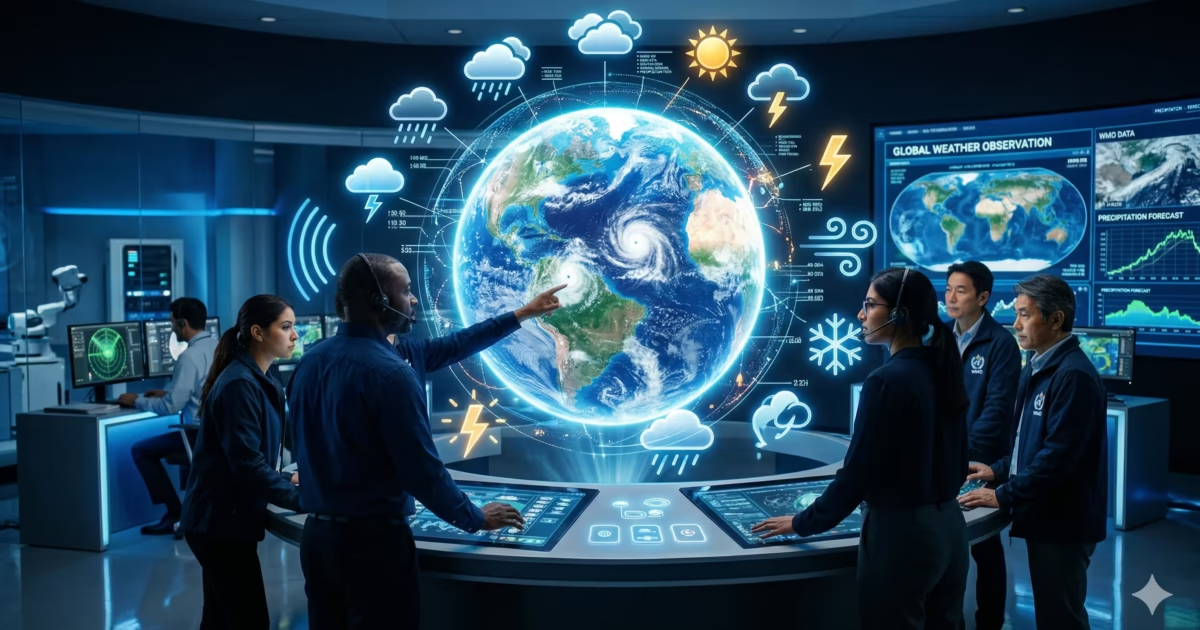
Have you ever wondered how your weather app knows exactly when it’s going to rain, or how airplanes safely navigate through massive storms? From deciding what to wear in the morning to ensuring global food security, the weather dictates almost every aspect of our lives.
Every year on March 23, the globe celebrates World Meteorological Day. This day honors the incredible, often invisible network of meteorologists, climate scientists, and Earth observers who work around the clock to keep our communities safe.
Here is everything you need to know about World Meteorological Day, its history, and the powerful theme for this year.
Table of Contents
History of World Meteorological Day
World Meteorological Day commemorates the establishment of the World Meteorological Organization (WMO). The official WMO Convention came into force on March 23, 1950.
However, global cooperation on weather is much older than that! The WMO actually replaced the International Meteorological Organization (IMO), which was founded way back in 1873. This means countries have been working together to share weather data for over 150 years.
The first official World Meteorological Day was celebrated in 1961, and it has grown every year since to become a crucial day for climate awareness.
What is the World Meteorological Organization (WMO)?
The WMO is a specialized agency of the United Nations. Because weather, climate, and the water cycle do not recognize national borders, international cooperation is absolutely essential.
The WMO acts as the “central nervous system” of global weather. It orchestrates the free and open exchange of observational data between 193 Member States and Territories, ensuring that no matter where you are—on land, at sea, or in the air—you have access to life-saving weather forecasts.
Theme for World Meteorological Day 2026
Every year, the WMO selects a specific theme to highlight a critical environmental issue.
The theme for World Meteorological Day 2026 is “Observing Today, Protecting Tomorrow.”
This powerful theme highlights the absolute necessity of collecting accurate weather, climate, and water data today to create a safer, more resilient future. It emphasizes that the millions of observations made daily—from satellites in space to ocean buoys riding the waves—are the foundation of early warning systems that protect us from natural disasters.
Read Also : World Water Day 2026: Theme, History, and Significance
Why World Meteorological Day Matters
Why should we care about meteorology? The work of National Meteorological and Hydrological Services impacts us in three major ways:
- Saving Lives (Early Warnings): Accurate forecasting is a matter of life and death. Advanced radar and AI models help experts issue early warnings for cyclones, floods, and heatwaves, giving vulnerable populations time to evacuate and prepare.
- Tackling Climate Change: Meteorologists provide the hard data needed to track rising temperatures, melting ice caps, and changing ocean currents. This data is the foundation of global climate action.
- Economic & Agricultural Impact: Farmers rely on monsoon and rain forecasts to plant crops. The aviation, shipping, and renewable energy sectors depend entirely on accurate weather data to function safely and efficiently.
The Evolution of Weather Forecasting
Weather forecasting has come a long way! Ancient civilizations relied on sky-gazing, observing animal behavior, and tracking the phases of the moon to predict the weather.
Today, meteorology is powered by supercomputers processing billions of calculations per second. We use advanced Doppler radar, AI-enhanced prediction models, and a network of satellites orbiting the Earth to predict storms days before they even form.
Fascinating Weather Facts
- Heavy Clouds: A single, fluffy cumulus cloud can weigh over 1 million pounds (about the weight of 100 elephants)!
- Extreme Winds: The fastest wind speed ever recorded on Earth was a staggering 253 mph (408 km/h) during Tropical Cyclone Olivia in 1996.
- Constant Lightning: Lightning strikes the Earth approximately 44 times every single second.
Inspiring Quotes About Weather and Climate
- “Climate is what we expect, weather is what we get.” — Mark Twain
- “There is no such thing as bad weather, only different kinds of good weather.” — John Ruskin
- “We are the first generation to feel the impact of climate change and the last generation that can do something about it.” — Jay Inslee
How to Observe World Meteorological Day
You don’t need to be a scientist to celebrate! Here are a few simple ways to participate:
- Educate Yourself: Take a few minutes to learn how to read a local weather radar map or explore the official WMO website to understand their global impact.
- Spread Awareness: Share the 2026 theme with your friends and family on social media using the hashtags #WorldMetDay and #WMO.
- Take Climate Action: Connect the day to your personal habits. Small steps like reducing energy consumption or supporting sustainable practices help protect our shared climate.
Conclusion
Understanding our weather is the key to protecting our future. World Meteorological Day is a beautiful reminder that while the forces of nature are incredibly powerful, human innovation and global cooperation are equally strong. By “Observing Today,” we are actively “Protecting Tomorrow.”
Over to you! What is your favorite type of weather, and how do you stay prepared for extreme conditions? Let us know in the comments below!