

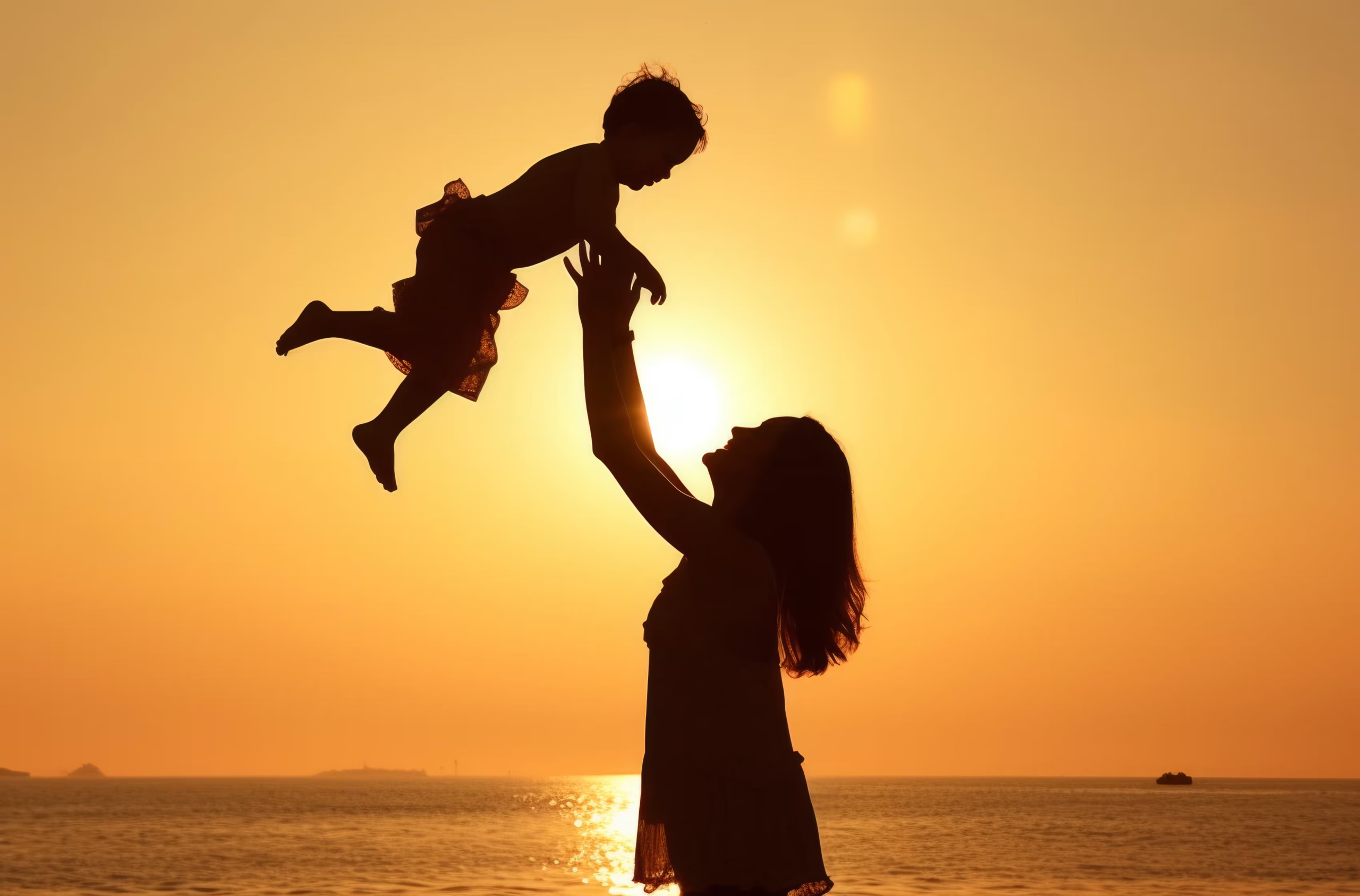
National Daughters Day has become one of the most shared family observances on the internet, but readers often get confused by multiple names—“National Daughters Day,” “International Daughters’ Day,” and even the colloquial “Worlds Daughters Day.” This guide clears up the terminology, explains how the date is chosen in different places, and provides verified 2025 dates so you can plan school announcements, community notes, and newsroom explainers with confidence. If you arrived here searching when is National Daughters Day, you’ll find a concise answer alongside context that prevents common mix‑ups with the United Nations’ International Day of the Girl Child.
Table of Contents
What is Daughters Day?
Daughters Day is a cultural and social observance celebrating daughters and the parent–child bond. Unlike statutory holidays, it does not arise from government legislation or a United Nations resolution, so traditions vary by country and sometimes even by region or community. In practice, media outlets, schools and families use the day to spotlight girls’ aspirations, education, safety and equal opportunities. The name differs by publication or organizer—some use National Daughters Day (especially in the United States), others prefer International Daughters’ Day (commonly used by calendars that follow a global convention). Regardless of the title, the intent is the same: to celebrate daughters and reaffirm a culture of equity and respect.
Daughters Day vs. International Day of the Girl Child
It is important not to conflate Daughters Day with the International Day of the Girl Child, a formal UN observance held every year on 11 October. The UN day addresses systemic issues affecting girls worldwide—education access, nutrition, child marriage, legal rights, health, and freedom from discrimination—and is backed by UN agencies and member‑state commitments. Daughters Day, by contrast, is a community‑driven celebration with no single global governing body; its date is set by custom and popular usage rather than international law or treaty.
When is Daughters Day in 2025?
Because Daughters Day is custom‑set, the date depends on the convention followed in your country. In 2025, American outlets commonly mark Thursday, September 25, 2025 as National Daughters Day, while India and many international calendars observe Sunday, September 28, 2025, following the practice of celebrating on the fourth Sunday of September. To avoid confusion in cross‑border contexts, it is best to state both dates at the top of any announcement or article.
To help editors and readers, here is a compact 2025 reference table. Use the “Observance rule” column to decide which line applies in your context.
| Country/Region | Observance rule typically followed | 2025 date | Notes |
|---|---|---|---|
| United States | Fixed date each year | Thu, Sep 25, 2025 | Often titled National Daughters Day; widely amplified on social media and lifestyle calendars. |
| India | Fourth Sunday of September | Sun, Sep 28, 2025 | Used by Indian media and brands; schools and communities often align events to the weekend. |
| United Kingdom | Fixed date in many UK listings | Thu, Sep 25, 2025 | Some UK sites also mention the fourth‑Sunday convention—check local calendars. |
| Canada | Fourth Sunday of September (many calendars) | Sun, Sep 28, 2025 | Community observance; not an official holiday. |
| Australia | Fourth Sunday of September (many calendars) | Sun, Sep 28, 2025 | Observed in community and social media calendars. |
| International listings | Fourth Sunday of September | Sun, Sep 28, 2025 | Appears on many “International Daughters’ Day” calendars and global observance sites. |
| Elsewhere | Varies by publisher/community | Check local convention | Some countries mirror the US fixed date; others follow the fourth‑Sunday rule or choose a separate local date. |
Upcoming year at a glance (2026)
| Country/Region | 2026 date | Rule |
|---|---|---|
| United States | Fri, Sep 25, 2026 | Fixed date (Sept 25). |
| India | Sun, Sep 27, 2026 | Fourth Sunday of September. |
| United Kingdom | Fri, Sep 25, 2026 | Fixed date in many UK listings. |
| Canada | Sun, Sep 27, 2026 | Fourth Sunday of September (many calendars). |
| Australia | Sun, Sep 27, 2026 | Fourth Sunday of September (many calendars). |
| International listings | Sun, Sep 27, 2026 | Fourth Sunday of September. |
How is the date decided?
Unlike Mother’s Day and Father’s Day—which have long‑standing and fairly standardized rules within each country—Daughters Day grew rapidly through media coverage and social sharing. As a result, two customs became dominant instead of one. In the US, publishers popularized September 25 as a fixed‑day hashtag event. In India and many international calendars, organizers preferred the fourth Sunday of September, making it easier for schools and families to participate. Neither system is “more official” than the other; each is a community norm. For globally distributed companies, the practical approach is to reference both dates and schedule localized posts or events accordingly.
Is Daughters Day 2025 the same in Canada & Worldwide?
In Canada, the date most commonly listed on calendars is September 25, 2025, aligning with the U.S. fixed‑date convention, while some organizations and communities also reference the fourth Sunday of September, which falls on Sunday, September 28, 2025. Because the observance is not statutory, both practices appear in use. Internationally, the pattern is similar: many countries adopt the fourth‑Sunday rule for weekend participation, while others mirror the U.S. fixed date. Presenting both 2025 dates—September 25 where a fixed date is followed and September 28 where the fourth‑Sunday rule applies—helps avoid confusion. The United Nations’ International Day of the Girl Child remains a separate observance on October 11.
History and public meaning
Daughters Day does not have a single founder with archival documentation comparable to early 20th‑century Mother’s Day campaigns; rather, it crystallized across the late 20th and early 21st centuries as conversations about girls’ rights, education and safety gained prominence. Newspapers and lifestyle magazines began running human‑interest features, while brands and NGOs used the day to support scholarship drives, STEM education, menstrual health awareness, and self‑defense programs. Over time, the observance came to serve two purposes at once: a personal celebration of daughters in the family, and a public reminder to build a world where every girl can learn, lead and thrive. That dual role explains why you will see both family‑centric stories and equity‑focused programming under the same banner.
Significance & themes
Daughters Day resonates for both personal and public reasons. At a family level, it is a moment to affirm love, belonging and mutual respect, and to acknowledge daughters’ achievements without stereotyping what they should study or become. In the public sphere, the day is often used to spotlight the unfinished work around girls’ education, health and nutrition, safety from violence, digital inclusion, and equal opportunities in sports, STEM and leadership. Schools and civic groups frequently pair celebrations with awareness activities that encourage bystanders to speak up, communities to create safer public spaces, and institutions to review policies—whether that is ensuring access to sanitary health support, closing participation gaps in coding and robotics clubs, or addressing online harassment. Many nonprofits and global initiatives working year‑round on these themes—such as UN‑affiliated programs, Girls Who Code, Malala‑inspired education efforts, and local self‑defense or scholarship drives—see late September as an on‑ramp for new volunteers and donors, even when the observance itself is not formally legislated.
How to celebrate
How people celebrate often reflects local culture and age‑appropriate choices, but a few settings recur worldwide. Within families, parents and guardians may write gratitude letters, curate photo stories that trace milestones, cook a favorite meal together, or set aside time for intergenerational conversations about aspirations, safety and digital wellbeing—treating the day as a ritual of listening rather than just gifting. In schools and colleges, assemblies and classroom segments can weave in quick explainers on girls’ rights, short poems or student essays, and moderated discussions on equal opportunities in sports and STEM, while guidance counselors coordinate life‑skills workshops on self‑defense, nutrition and mental health. Workplaces often use the observance to run inclusive messages across internal channels, publish employee spotlights that normalize women’s leadership, host mentoring circles, and review flexibility or safety policies that affect caregivers and young employees. Community organizations—from local libraries to resident associations—tend to anchor the day around book‑donation drives, neighborhood reading circles, health check‑ups, first‑aid and self‑defense camps, or fundraisers that support girls’ education and safety in their own city; these programs keep the spirit of celebration grounded in practical change.
Frequently asked questions
Is it “Daughter’s Day” or “Daughters Day”?
Both appear in print. Style guides that avoid possessives in holiday names typically use Daughters Day (no apostrophe), while some outlets publish Daughter’s Day. For search visibility and consistency, many newsrooms standardize on National Daughters Day.
Is it an official holiday?
No. It is a social/cultural observance. Schools and offices remain open unless a local authority separately declares a celebration.
How is Daughters Day different from the UN’s Day of the Girl on October 11?
The UN day is a formal, internationally recognized observance centered on girls’ rights and policy priorities. Daughters Day is a popular celebration with locally chosen dates. Many organizations observe both: community content in late September and advocacy programming on October 11.
Does my country follow the US or the fourth‑Sunday rule?
If your local press and schools reference September 25, follow the fixed date. If they reference the fourth Sunday of September, use that. In cross‑border contexts, mention both conventions with the 2025 dates to avoid confusion.
Editorial and planning notes for publishers
If you are building a newsroom explainer or a school/brand blog, consider highlighting both phrasings—“when is National Daughters Day” and “International/Worlds Daughters Day date”—because readers search using all three. Include the country‑specific line in the opening paragraph (“In India, it’s the fourth Sunday of September; in the United States, September 25”) and add a small date table like the one above. To deepen value, place a short primer on the International Day of the Girl Child (11 October) immediately after the date information, then link to related coverage on women’s education, safety and digital wellbeing. This structure answers the core query while keeping the piece substantive and evergreen without relying on celebratory quotes or captions.
Read also : Faithwing Christian Jewelry: 5 Beautiful Cross Necklaces to Gift (and Wear) in 2025
Read Also : 6 priorities for women and health


